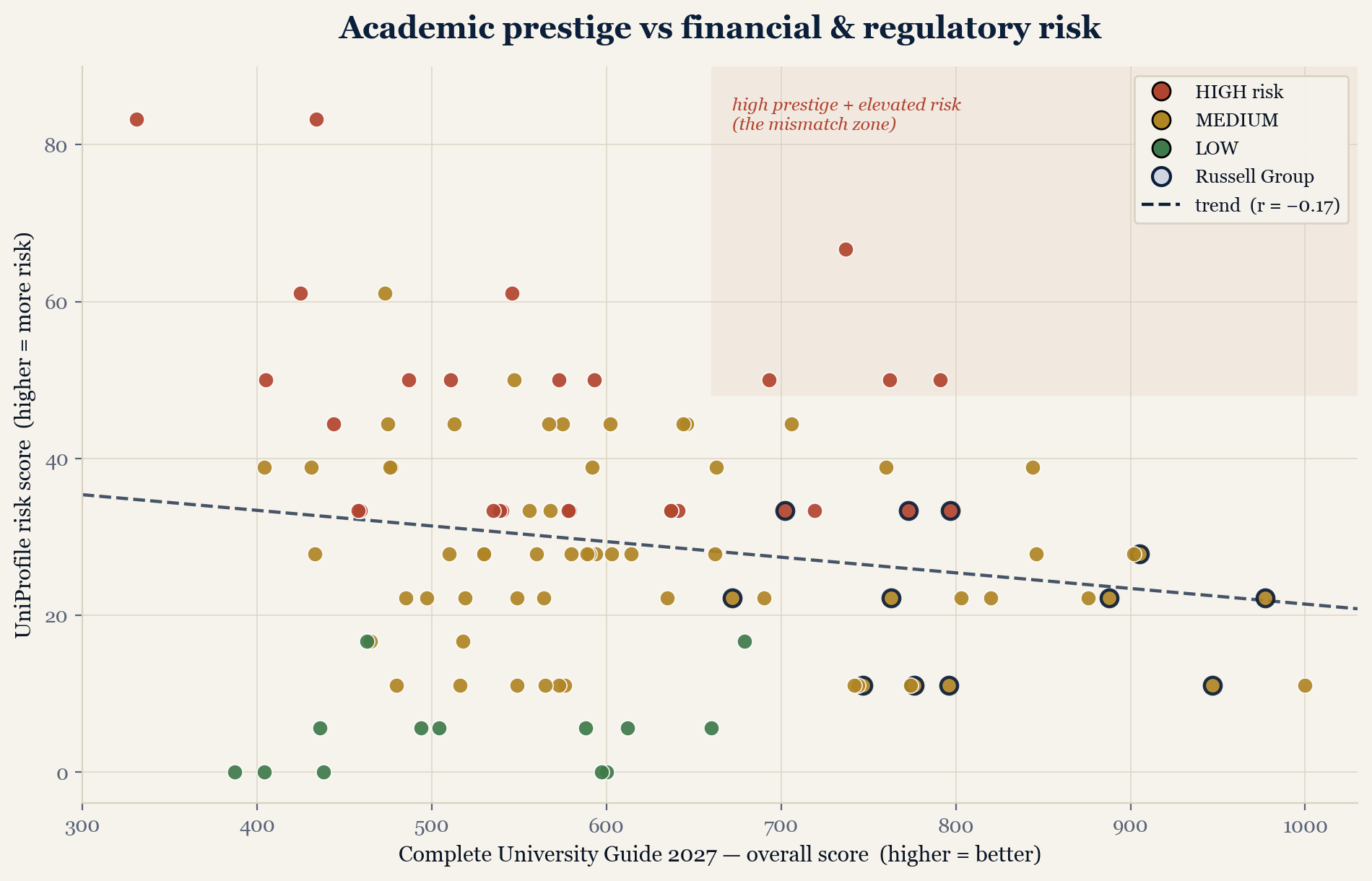
Set a university's ranking next to its financial health and the silence is measurable. Across the 106 English universities that appear both in the Complete University Guide's 2027 table and in the data we analyse, the relationship between league-table standing and financial-and-regulatory risk is almost nothing.
The statistical correlation is −0.17. In plain terms, league-table rank explains under 3% of the variation in financial and regulatory risk. Where a university sits in the rankings tells you almost nothing about whether it is financially or regulatorily exposed.
The reason is structural, not incidental. League tables grade entry tariffs, student satisfaction, research quality, spend per student and graduate outcomes — the ingredients of desirability. A risk view grades something different: solvency, the collapse in overseas postgraduate demand, and visa-refusal exposure — the things that bear on whether a course will still be running, and properly resourced, when a student arrives. The two sets of measures barely overlap. So the rankings cannot stand in for the risk picture, however carefully they are read.
Risk does not sit at the bottom of the table
The intuitive defence of using rankings as a safety proxy is that risk must cluster at the bottom — that the universities under strain are the ones the table already marks as weak. The data does not support it. Sorting the 106 universities into four quartiles by league-table standing, the higher-risk institutions are split almost evenly between the most prestigious quartile and the least: seven against eight.
| League-table quartile | Higher risk | Medium | Lower risk |
|---|---|---|---|
| Q1 (most prestigious) | 7 | 20 | 0 |
| Q2 | 4 | 16 | 6 |
| Q3 | 8 | 19 | 0 |
| Q4 (least prestigious) | 8 | 11 | 7 |
Source: Complete University Guide 2027 (prestige) and HE Perform model, 2024/25 financial vintage (risk tier). "Higher risk" and "lower risk" correspond to the model's HIGH and LOW tiers.
The table also overturns the assumption in the other direction. Among the 27 most prestigious universities in this sample, not one carries a lower-risk rating — every one flags at least medium. The lower-risk universities here all sit in the bottom quartile for prestige. Put bluntly: the institutions a rankings-led search discards first are, in this data, among the most financially stable of the set.
Of the 41 universities in the top half of the table, 39 register medium or higher risk. A family screening on rank alone would treat almost all of them as the safe choices.
Two different questions
None of this makes the league tables wrong. They measure what they set out to measure, and they do it well. The point is narrower, and it matters: prestige and stability are different questions, and the answer to one does not contain the answer to the other.
UniProfile's view
Anyone choosing a university on rank alone is reading a quality signal and trusting it as a stability signal. In our view those are not the same thing, and the gap between them is exactly where an avoidable surprise lives — a course restructured, a department merged, a campus that feels thinner than the prospectus promised, at an institution the rankings called excellent.
That is the gap a UniProfile report is built to close. It doesn't rank universities or tell you where to go. It reads the official financial, regulatory and demand data on the one university you're weighing up, and gives you a clear, independent view of how stable it looks — the half of the decision the league tables were never measuring.
UniProfile's view is the editorial opinion of UniProfile, based on the data shown on this page. It is not a statement of fact about any institution, and not financial advice.